
Spend time at any serious energy conference today and one message keeps resurfacing, no matter the speaker or country: hydrogen is already in use. Electrolyzers are operating beyond pilot scale. Fuel cells are supporting real systems, not just demonstrations. What has shifted quietly is the role universities are expected to play. Teaching hydrogen as a standalone topic or a closing chapter no longer reflects reality. This change has pushed the hydrogen lab to the centre of modern engineering education.
A hydrogen lab is not built to look impressive. It exists to confront students with the parts of hydrogen systems that are rarely tidy. Output fluctuates. Sensors drift. Alarms interrupt experiments. Safety logic overrides human intent. None of this feels smooth, but all of it reflects how green hydrogen systems behave outside academic settings. That realism is the point.
When Hydrogen Stops Feeling Abstract
Most students first meet hydrogen through equations and block diagrams. On paper, the process appears straightforward. Electricity enters the system, hydrogen exits, and efficiency is expressed as a percentage. That clarity disappears quickly once students step into a hydrogen lab.
Electrolyzers respond immediately to power quality. Minor voltage variations create visible changes in hydrogen output. Temperature rises faster than expected. Water quality begins to matter in ways textbooks rarely emphasize. These observations force students to engage differently. Hydrogen stops being a concept and starts behaving like equipment that demands attention.
That shift cannot be rushed or explained away. It happens only through exposure.
Learning by Producing Green Hydrogen
The most effective learning in a hydrogen lab comes from direct operation. Students work with laboratory-scale electrolyzers under varying conditions. They adjust current limits, observe cell voltage behavior, and track hydrogen flow in real time.
Not every experiment runs smoothly. Output drops unexpectedly. Systems shut down. Those interruptions leave a stronger impression than successful trials. Students begin to understand why efficiency is fragile and why operating limits exist in real projects.
By the end of these sessions, green hydrogen stops being about maximum output and becomes about stable, repeatable operation.
Storage Changes How Hydrogen Is Viewed
Hydrogen storage is often underestimated at first. In practice, it shapes many design decisions. Hydrogen labs expose students to buffer tanks, cylinders, pressure regulation, and drying systems.
Working with these components alters perspective. Pressure is no longer just a value on a screen. Leak detection becomes personal. Safety protocols feel necessary rather than procedural. Alarms are no longer theoretical events.
These experiences form habits that carry into professional environments, where caution and discipline are essential.
Fuel Cells Complete the Energy Picture
Many hydrogen labs integrate fuel cells to close the loop between production and use. This stage often challenges expectations. Hydrogen-to-electricity conversion introduces losses that are hard to ignore. Thermal behaviour becomes a constraint. Power output varies under load.
Students begin to see hydrogen for what it is: an energy carrier with trade-offs. It solves specific problems but introduces others. That balanced understanding is difficult to achieve without seeing the entire cycle in operation.
Engineers trained this way tend to design systems with fewer assumptions and more realism.
Hydrogen Labs as Research Environments
At postgraduate level, the hydrogen lab takes on a different role. It becomes a space for observation rather than instruction. Systems are operated for longer periods. Components age. Measurements drift. Results stop matching simulations.
This is where research becomes meaningful. Performance mapping, degradation analysis, and control studies require real hardware. Data from electrolyzers and fuel cells often challenges assumptions early. Models need revision sooner than planned.
For many universities, the hydrogen lab serves as a filter. Ideas are tested at small scale, impractical approaches are exposed quickly, and stronger concepts mature before moving toward pilot systems.
Why Renewable Integration Matters in Practice
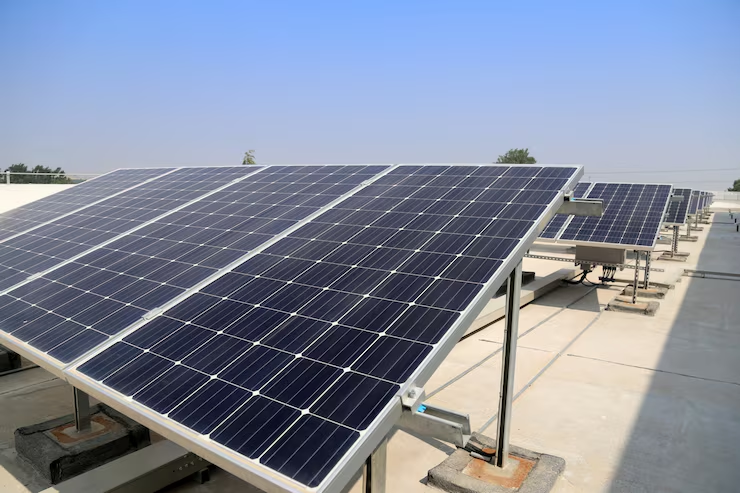
Hydrogen only becomes truly relevant when it interacts with variable power. Renewable integration inside the lab introduces this reality. When electrolyzers are connected to solar PV, wind emulators, or microgrids, input conditions fluctuate constantly.
Hydrogen production responds immediately. Control limits are reached faster. Operating decisions begin to matter. Students also see why hydrogen is discussed alongside batteries rather than as a replacement. Hydrogen works best when it absorbs excess energy and provides flexibility over time.
Working under these conditions removes the illusion of ideal inputs and places hydrogen in its intended role within energy systems.
What Industry Looks for in Graduates
Companies working with hydrogen rarely struggle to find theoretical knowledge. The real challenge is finding engineers who understand how systems behave when conditions are less than ideal.
Graduates with hydrogen lab experience tend to recognize warning signs earlier. They respect safety interlocks. They adapt more quickly when systems behave unexpectedly. In most teams, that difference becomes visible very quickly.
This practical awareness is difficult to teach outside a laboratory environment.
A Long-Term Decision for Universities
Establishing a hydrogen lab is not a short-term branding effort. It is a strategic academic investment. These labs support interdisciplinary teaching, attract research collaboration, and keep programs aligned with active energy technologies.
Unlike static course content, hydrogen labs evolve. Components change. Configurations are updated. Learning remains current as systems develop.
Conclusion
Green hydrogen is already part of the present energy landscape. Universities that want to remain relevant must move beyond theoretical treatment. A modern hydrogen lab places students inside working hydrogen systems, where production, storage, utilization, and safety are experienced directly.
These labs do not prepare students for a distant transition. They prepare them for the hydrogen economy they are already entering.