Image generation is often described as “making pixels appear out of thin air”, but the most reliable approaches do not guess the whole image at once. They build it step by step. PixelCNN is a classic example of this idea. It generates an image one pixel at a time by learning the probability of each pixel given the pixels that came before it. This “autoregressive” logic is simple to state, yet powerful enough to model complex textures, edges, and local patterns. If you are exploring modern generative modelling through a generative ai course, understanding PixelCNN gives you a clean mental model for how likelihood-based image generation works and why architectural constraints matter.
The Core Idea: An Autoregressive Factorisation
PixelCNN treats an image as a sequence. Usually, it follows a fixed ordering such as left-to-right, top-to-bottom (raster scan). Instead of modelling the probability of the entire image directly, it breaks it into a product of conditional probabilities:
- The first pixel is predicted with no context.
- The second pixel is predicted given the first.
- The third is predicted given the first two, and so on.
This is not just a conceptual trick. It allows the model to be trained using maximum likelihood. In practice, training reduces to a supervised learning problem: predict the next pixel value (or distribution over pixel values) from the already-known previous pixels. Because we can compute the exact likelihood, PixelCNN avoids some of the instability seen in adversarial training, and it provides a clear objective function.
Masked Convolutions: Enforcing “No Peeking”
A normal convolutional neural network sees a neighbourhood around each pixel. That is a problem here. If the network can look at the pixel it is supposed to predict (or any “future” pixel), it will cheat during training and fail during generation.
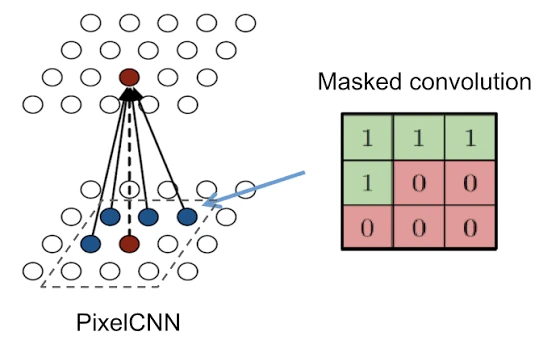
PixelCNN solves this using masked convolutional layers. A mask is applied to each convolutional filter so that, for any target pixel, the network only uses information from earlier pixels in the chosen ordering. The mask literally zeros out weights that would connect the target position to future pixels.
Two common mask styles are used:
- Mask A blocks the current pixel as well, typically used in the first layer.
- Mask B allows access to the current pixel’s already-computed internal features, used in later layers while still preventing access to future pixels.
With stacked masked convolutions, PixelCNN can build a deep receptive field over valid context pixels, meaning it can condition on a large portion of the already-generated image while remaining causally correct.
Output Distributions: From Discrete Pixels to Colour Channels
Pixels are usually represented as discrete values (for example 0–255 per channel). PixelCNN outputs a probability distribution rather than a single pixel value. During training, the model is penalised when it assigns low probability to the true pixel value, typically using cross-entropy loss.
For colour images, handling channels matters. A simple approach predicts red, then green given red, then blue given red and green for the same spatial position, while also conditioning on earlier spatial pixels. This keeps the model consistent with the idea of “past context only” but still captures within-pixel channel dependencies.
Many learners encounter PixelCNN while studying structured probabilistic modelling in a generative ai course, because it connects neural networks with explicit probability factorisations in a way that is easy to validate and reason about.
Sampling: Why Generation Is Correct but Slow
PixelCNN generation is straightforward:
- Start with an empty image grid.
- For the first pixel, sample from the predicted distribution.
- Move to the next pixel, sample again, and repeat until the image is complete.
This produces coherent results because each decision is conditioned on earlier decisions, and the model has learned those conditional relationships from data.
The main drawback is speed. Sampling is sequential, so generating a single image can require tens of thousands of prediction steps (one per pixel, often multiplied by channels). Researchers introduced caching tricks and architectural improvements (such as gated activations and refined output parameterisations) to reduce overhead, but the fundamental sequential nature remains.
Where PixelCNN Fits Among Modern Generators
PixelCNN is not the trendiest generator today, but it remains an important reference point:
- Compared to GANs, it is trained with a stable likelihood objective, but often produces less sharp images and is slower to sample.
- Compared to diffusion models, it has an exact likelihood and a clear causal structure, but diffusion models tend to scale better for high-resolution generation with parallelisable training dynamics.
Even if you never deploy PixelCNN in production, it teaches two durable lessons: (1) modelling choices become architectural constraints, and (2) enforcing those constraints (with masking) can turn a hard generative problem into a tractable learning objective.
Conclusion
PixelCNN generates images by converting image creation into a sequence prediction task. Masked convolutions prevent the network from “seeing the future,” ensuring each pixel is predicted only from valid context. This design enables stable maximum-likelihood training and produces logically consistent samples, even though the generation process is slow due to its step-by-step nature. If you are building strong fundamentals through a generative ai course, PixelCNN is a valuable model to study because it makes the mechanics of generative modelling explicit: probability factorisation, causal conditioning, and architecture working together to generate pixels with discipline rather than guesswork.


